First 3D map of the ovary across the reproductive lifespan
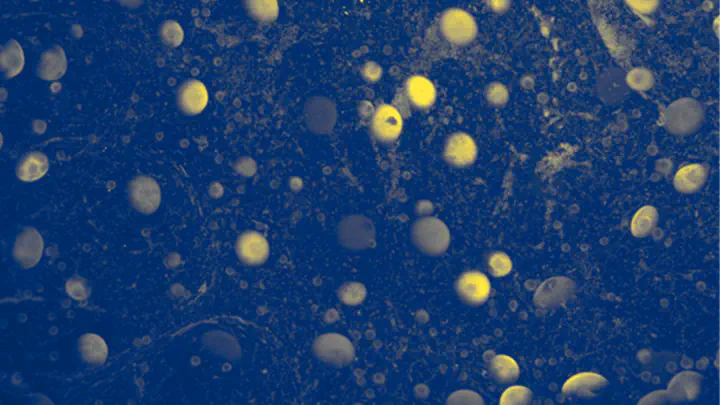
We are pleased to announce the publication of “Three-dimensional mapping of intact ovaries reveals the aging dynamics of the ovarian reserve” in Nature Aging.
In collaboration with researchers at the Centre for Genomic Regulation (CRG), EMBL Barcelona, DIPC, UPV/EHU and the Biofisika Institute, the study delivers the first complete three-dimensional map of the mouse ovary across its reproductive lifespan. The researchers combined whole-organ light-sheet microscopy, AI-based segmentation and mathematical modelling to identify and classify more than 85,000 oocytes in over 100 intact ovaries.
The work shows that, even as the ovarian reserve declines markedly with age, the fraction of oocytes in the transition from dormancy to growth remains stable at around 14%. This finding suggests that the ovary actively regulates its reserve rather than acting as a passive store of egg cells. The study also reveals substantial variation in ovarian reserve between genetically identical mice, links local oocyte density to activation, and identifies a previously unrecognised bottleneck during oocyte growth.
CVPD contributed to the AI-based image-segmentation workflow through BiaPy. The complete workflow, microscopy data and trained model have been openly released, enabling other researchers to reproduce the analysis and apply it to their own images.
The findings establish a quantitative framework for studying ovarian aging. While the research was carried out in mice, the authors also demonstrated the method on human ovarian cortex tissue, opening a path towards future studies in humans.
This work was supported by CVPD’s TOSBI, AIM-Net and CALM4GRAINS projects, funded by the Spanish Ministry of Science, Innovation and Universities and the State Research Agency (MICIU/AEI).

Read more:
Image credit: Arturo D’Angelo/CRG.
Daniel Franco-Barranco
Postdoctoral Researcher
My primary focus is on the development of deep learning solutions for the segmentation of organelles in large-scale and multimodal electron microscopy images.
Ignacio Arganda-Carreras
Ikerbasque Research Associate Professor
My research interests include image processing, computer vision, and deep learning for biomedical applications.